

Aloha hungry minds,
First the California roll. Now this.
Apparently, grocery shopping requires an in-depth background check.
Take London Broil. A name with posture. A name that owns a wool coat and knows which fork to use. You see it at the meat counter and assume you’re buying something specific, with a history somebody could explain if you bothered to ask. I can still picture the butcher wrapping it up in white paper like he did when I was a child shopping with my grandfather.
Then my mind wanders down a dark rabbit hole and I ask myself, just where in London did it come from?
Which cut of beef is it?
Why are three recipes giving you three different answers?
You came in for dinner. Now you’re conducting an investigation beside the hamburger.
The passport problem
London broil is generally considered an American dish. James Beard credited Philadelphia, although the historical account assembled by Cooks Info notes that he offered no evidence for that birthplace. The name’s origin remains unsettled.
Philadelphia may have a claim. London has excellent name recognition.
I’m calling it geographical catfishing.
You’ll find stories placing the dish’s invention in the 1930s. Unfortunately, the paperwork refuses to cooperate.
Merriam-Webster dates the term’s first known use to 1902. Etymologist Barry Popik cites an entry in F. Sturgis Allen’s What’s What from that year describing a “false fillet” broiled rare. That dates the name; it doesn’t identify the person who first cooked the dish. (merriam-webster.com, barrypopik.com)
Still, if your origin story starts in the 1930s, a 1902 reference is an awkward guest at the party.
And we have more than a dictionary.
Dinner, with receipts
On August 18, 1919, New York’s World Restaurant advertised London broil with French-fried potatoes for 40 cents in The Evening World. The advertisement also invited customers to enjoy the city view.
Dinner and scenery. Honestly, a compelling offer.
By November 25, 1922, the same newspaper’s market column listed “London broil, commonly known as flank steak” at 32 cents a pound. Round and sirloin were 45 cents.
An economical cut with a name that sounded like it had inherited property in the English Countryside.
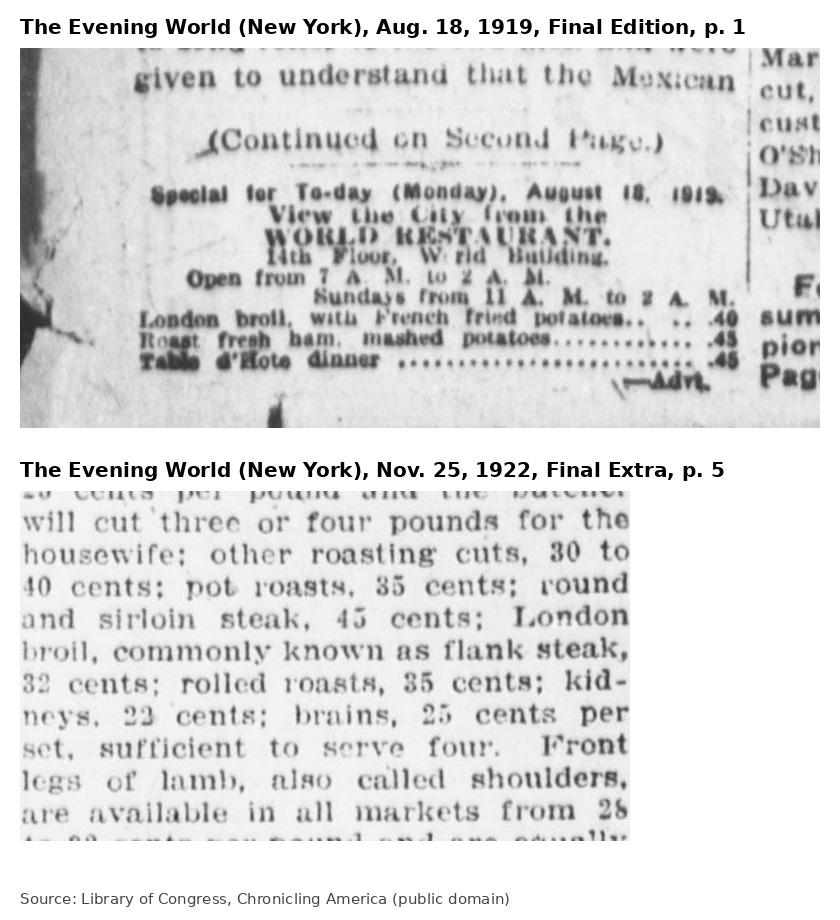
The Evening World, August 18, 1919, p. 1, and November 25, 1922, p. 5. Library of Congress, Chronicling America.
Those prices establish a useful piece of the story: London broil was associated with a less expensive cut. They don't show that someone deliberately invented the name to charge more.
That distinction matters, especially in an article accusing dinner of having a credibility problem.
Somebody understood branding. Maybe.
One theory is that “London” made the dish sound more sophisticated or expensive. Popik raises that possibility, but the naming story remains unproven. (barrypopik.com)
As someone who works in marketing, I understand the appeal.
“Flank steak” tells you something about the animal. “London broil” lets your imagination book a flight.
Before you’ve tasted anything, the name has supplied atmosphere. Maybe a restaurant with heavy silverware. Maybe a tradition. Certainly something more glamorous than standing in slippers under fluorescent lights, comparing packages.
I would love to tell you a butcher dreamed this up one slow Sunday and went home pleased with himself.
We don’t know that.
We know the name survived. And it’s still doing a remarkable amount of talking for two words.
Dinner has an alias
Here’s where the meat counter gets interesting.
London broil doesn’t reliably identify one anatomical cut. Flank steak has a long association with the dish, but the beef industry’s own materials recognize other uses of the name.
On the Beef Checkoff’s Beef. It’s What’s For Dinner. website, “London Broil” appears under “Also Known As” for both top round steak and top round roast. (beefitswhatsfordinner.com, beefitswhatsfordinner.com)
We went looking for a birth certificate and found another assumed name.
The industry recognizes the term. It just doesn’t give London broil its own distinct place on the cow.
And this confusion has been around long enough to qualify for senior discounts. In 1974, Beard complained that butchers and supermarkets were putting the name on several different cuts, including top round. (freebeacon.com)
It would be convenient to say London broil began as a restaurant dish and only much later became a label for raw meat.
But remember that 1922 market column? It was already selling the name by the pound.
The restaurant identity and the butcher-counter identity were overlapping early. This steak has been maintaining multiple accounts for more than a century.
The plot thickens, unlike the slices.
Perhaps the recipe will clear things up.
Adorable thought. Yeah, nope.
Today, London broil commonly involves lean beef, a marinade, high heat, and thin slicing across the grain. But historical recipes didn’t all follow the same script. (barrypopik.com)
A 1923 Ohio newspaper column described making it from leftover rib roast, sliced and quickly broiled. In 1965, American Home published a version using flank steak, salt, pepper, garlic powder, and butter. No overnight marinade. (cooksinfo.com, usmodernist.org)
An uncertain birthplace. Several possible cuts. Different preparations.
The potatoes are beginning to look like the only witnesses with a consistent story.
But underneath all this identity confusion is something I respect: people figuring out how to make a good meal.
Knowing what a cut needs. Cooking it accordingly. Slicing it thoughtfully. Giving yesterday’s roast another appearance without making everyone at the table feel punished.
That takes knowledge. The sort that doesn’t need a glamorous name to be valuable.
So, is it a food lie?
Affectionately, yes.
We haven’t uncovered an international steak conspiracy. No evidence of a butcher in a back room stamping tiny passports.
We have a name that encourages assumptions it cannot reliably answer for.
And we participate, willingly. We hear a place and imagine a history. We recognize a label and assume we understand the product.
Eventually, a familiar word slips past our curiosity wearing a little badge that says, You already know me.
Except sometimes we don’t.
That’s why this story interests me. A name can make food appealing, memorable, even beloved. It can also leave us surprisingly uninformed about the thing we’re carrying home.
So buy the London broil if it looks good.
Ask which cut it is. Ask how best to cook that particular piece. Give the actual beef at least as much attention as its impressive introduction.
I’m still perfectly willing to have it for dinner.
But I’m done pretending I’ve met its family.
Until next time, Lorie