

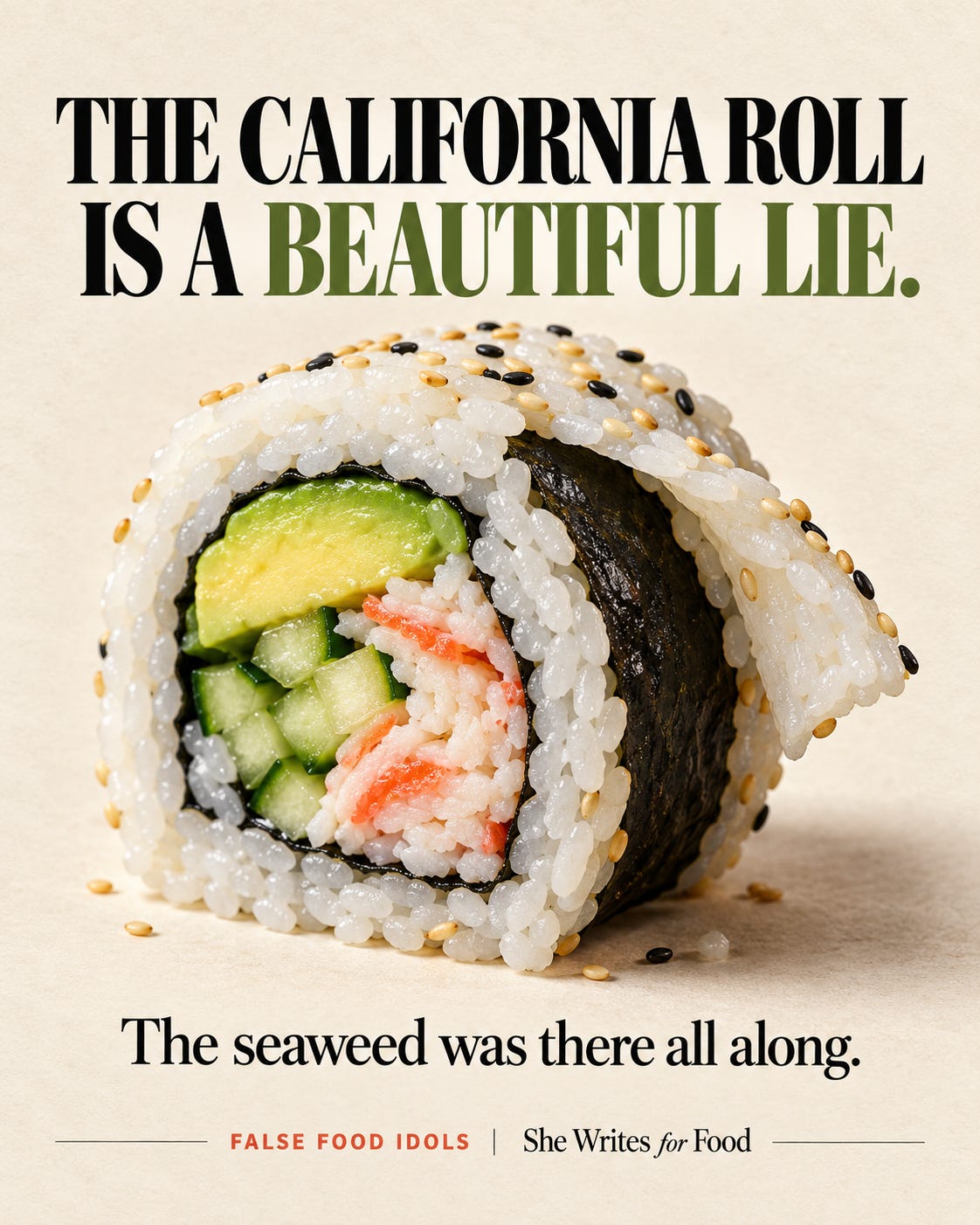
The California roll is the sushi that lied to your face—but in a good way.
It showed up, smiled politely, hid the seaweed like a dirty little secret, and said, “Trust me.”
And America did.
Let’s get this out of the way: The California roll might be from California. It might be from Canada. Its origin story has competing chefs, disputed credit, and enough geographical confusion to require a moderator. What we can say is that it’s a North American adaptation of Japanese sushi, with Japanese chefs at the center of its creation. (en.wikipedia.org)
Which makes this less a story about somebody faking another culture’s food and more a story about people figuring out how to introduce their food to a new audience.
Someone looked at hesitant diners in the 1960s and ’70s and apparently thought: They’re not ready. But they could be.
First, a little history. Because even a beautiful lie needs a fact-check.
One widely repeated account credits chef Ichiro Mashita and his assistant, Teruo Imaizumi, at Tokyo Kaikan in Los Angeles’ Little Tokyo. In that telling, avocado became a substitute for fatty tuna when it was unavailable. Its rich texture offered some of the same creamy satisfaction. Accounts also describe turning the seaweed inward because some customers peeled it off. The dates and details vary, which is your first clue that this history does not come with a tidy birth certificate. (en.wikipedia.org, pacificcitizen.org)
Then there’s Ken Seusa at Los Angeles’ Kin Jo restaurant. A 1979 Associated Press story credited him as the inventor, citing the restaurant’s manager. That’s an early published claim, not a final verdict—but it complicates any declaration that California had nothing to do with the California roll. (en.wikipedia.org)
Meanwhile, Vancouver chef Hidekazu Tojo tells his own story of creating an inside-out roll for customers reluctant to eat raw fish or visible seaweed. Cooked crab offered a familiar introduction; rice on the outside kept the nori out of sight. His claim remains part of the dispute. His contribution to Japanese cuisine, however, received official recognition when Japan named him a goodwill ambassador for Japanese cuisine in 2016. (smithsonianmag.com, en.wikipedia.org)
So no, we cannot confidently announce that Japan was never consulted. Japanese chefs were doing the translating. And Japan eventually handed one of them an ambassadorship.
That is considerably more diplomatic than a cease-and-desist.
Across these accounts, the recurring ingredients are practical problems and creative solutions: what chefs could source, what customers would try, and how to get someone past the first suspicious glance.
Cooked crab made the introduction. Avocado stepped in as the creamy comfort cousin. The seaweed? Flipped inside and buried under rice like it was ashamed to be there.
That inside-out construction is called uramaki. The disguise had a name. (en.wikipedia.org)
And suddenly, sushi felt approachable.
A gateway food with excellent PR.
People love to argue about food authenticity. But what interests me about the California roll is its ability to translate.
A bridge. An invitation. A familiar ingredient holding the door open for an unfamiliar one.
That resonates with me because so much of my work involves building bridges and translating topics. How do you help someone understand something they’ve already decided isn’t for them? How do you give them a way in?
I even prefer politicians who build over those who blame. Apparently, my politics and my lunch have something in common.
The California roll didn’t ask you to understand Japanese knife work or regional fish traditions. It didn’t demand bravery.
It just asked you to chew.
And that matters.
For many North American diners, the California roll was an introduction to sushi—a role explored in food histories and, more recently, the documentary California Roll: The Rise of American Sushi. (smithsonianmag.com, pacificcitizen.org)
Not toro. Not uni. Not an omakase menu whispered about in reverent tones.
A California roll at a strip-mall restaurant, drowned in soy sauce, followed by the realization: Oh. This isn’t scary.
That first bite opened the door.
Food purists love to roll their eyes at the California roll, but let’s be honest—plenty of us have a food “starter boyfriend.” The one who’s safe, a little basic, but gets you in the door.
Butter chicken. Chicken Alfredo. Teriyaki chicken. Fish tacos for people who “don’t like fish.”
You don’t get to judge the gateway if you walked through one yourself.
And you don’t have to graduate from it, either. You’re allowed to love a California roll forever. Lunch is not a certification program.
The real lie is what we think counts.
Here’s the correction that matters: A California roll is real sushi.
Sushi does not require raw fish. The seasoned rice is fundamental; cooked seafood and vegetables belong in sushi, too. An inside-out roll with crab and avocado doesn’t lose its membership because nobody served you raw tuna. (allrecipes.com)
Calling it fake would repeat the very food snobbery I’m arguing against.
The California roll helped expand the table. It made space for people who didn’t grow up with raw fish as a casual option. To me, that’s a compelling example of cultural adaptation: chefs using their skills to make a connection.
And yes, it’s funny that a roll named California has a serious Canadian contender for its origin story. “California” is doing an impressive amount of branding work here.
But the history tells us something more interesting about how food can spread: through creativity, adjustment, and a willingness to meet people where they are.
The “lie” was the camouflage. The seaweed was there all along. You just needed to get to know it before making a scene.
Food marketing gives us plenty of stories worth questioning. That doesn’t change the fact that I love California rolls and California roll poke.
I can interrogate the branding and still order lunch.
Not all food lies are bad. Some are just introductions.
Unraw. Unscary. Unapologetically user-friendly.
And for a lot of us? The beginning of a much bigger appetite.