

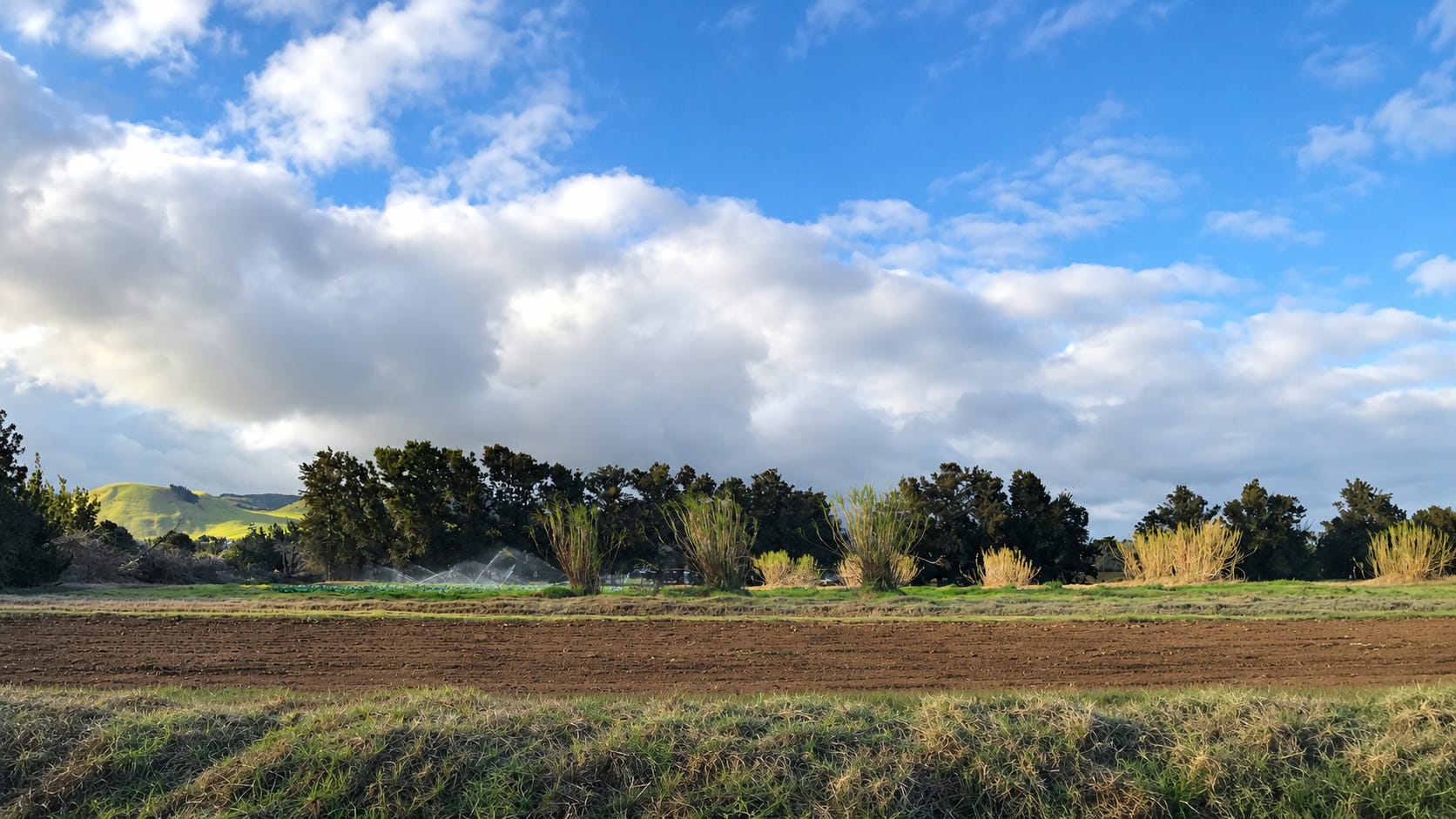
Kamuela, Hawaiʻi Island. 20 years ago, the Lalamilo farm lots produced roughly 30 percent of Hawaiʻi’s green leafy vegetables. No longer.
Dearest readers,
There's something I've been thinking about lately.
I took the photograph that accompanies this essay in Lālamilo, on the Kamuela farm lots on Hawaiʻi Island.
About 20 years ago, this area was responsible for a substantial share of Hawaiʻi’s leafy green vegetable production.
I remember estimating that the area produced roughly 30 percent of the state’s supply of green leafy vegetables, using data from the Hawaiʻi Agricultural Statistics Branch.
I did that research because the County Council proposed paving a road through the farm lots.
The argument was that the road would benefit everyone. But I didn’t see how shaving a few minutes off someone’s commute justified disrupting one of Hawaiʻi’s important food-producing areas.
We fought the proposal, and they didn’t build the road.
But here’s what I remember most.
It was one more fight the farmers had to endure.
One more threat to their operations. One more issue that required meetings, testimony, paperwork, phone calls, and time they could have spent farming.
People talk about farmers’ resilience as though it’s an unlimited resource.
It isn’t.
Every bad policy decision, every unnecessary obstacle, every disaster takes something out of that reserve of determination.
How much can we expect farmers to absorb before they’ve had enough?
Today, farming hasn’t disappeared from Lālamilo. But the concentration of commercial vegetable production that once made this area so important to Hawaiʻi’s food supply isn’t what I remember.
I think about places like Lālamilo whenever another storm tears through the islands, and we begin adding up the agricultural damage.
We count the flooded fields, destroyed crops, damaged greenhouses, broken fences, and washed-out roads. Government agencies announce disaster programs. Agricultural organizations begin collecting damage reports. Politicians promise to help farmers recover.
And eventually, the news moves on.
But here’s something I’ve learned from years of working with Hawaiʻi agriculture.
Not every farmer comes back.
Sometimes the storm doesn’t put a farmer out of business.
Sometimes it simply makes the decision easier.
When the numbers stop working
Farmers are a stubborn bunch.
If a farmer is growing crops, making money, and enjoying the work, chances are that farmer will find a way to keep going.
Equipment breaks. Weather happens. Prices fluctuate. Labor is hard to find. Something always needs fixing.
That’s farming.
But what happens when a farmer is getting older?
Maybe retirement has been on the horizon for a few years. Maybe the tractor needs replacing. Maybe finding reliable workers has become an annual headache. Maybe the farmer has spent decades navigating rising costs, changing regulations, paperwork, and requirements that seem to multiply every year.
The farm is still operating. There’s still a crop in the ground. Bills are getting paid.
But the margins aren’t what they used to be.
And perhaps the farmer is tired.
Then the storm comes.
The fields flood. The irrigation system needs repairs. Fences go down. The crop that was supposed to pay the bills for the next several months is gone.
Now comes the real work.
Clean up. Repair. Replant. Find financing. Apply for assistance. Wait for reimbursement. Figure out how to pay the workers. Figure out how to pay yourself.
And somewhere in the middle of all that, the farmer sits down and does the math.
Maybe rebuilding means taking on debt at an age when paying off debt wasn’t supposed to be part of the plan.
Maybe replacing the trees means waiting years for another meaningful harvest.
Maybe the farm needs equipment that costs more than the next several years of profits could justify.
And maybe, for the first time, the answer isn’t to get back out there and start again.
Maybe the dollars no longer make sense.
Maybe it’s time to park the tractor.
I’ve seen this before
In the spring of 2019, I conducted a market assessment for the proposed Puna Agricultural Park on Hawaiʻi Island.
The work included 59 in-depth interviews with agricultural leaders, farmers, and stakeholders, along with surveys, industry discussions, and an examination of agricultural census data.
The assignment was to determine whether farmers needed or wanted another agricultural park in Puna.
But the conversations revealed something much bigger.
My analysis of the 2017 USDA Census of Agriculture showed Hawaiʻi Island had lost 9.25 percent of its farm operations over the preceding decade.
My analysis also identified an average decline of approximately 15 percent among farms in the 10-to-179-acre size categories.
Those numbers concerned me because these weren’t simply backyard gardens. Farms of that size represented an important part of Hawaiʻi Island’s commercial agricultural capacity.
And there was another pattern.
Puna had endured repeated storms, volcanic eruptions, and other disruptions. Some producers had rebuilt more than once.
In my interviews, I heard resilience. Determination. Pride.
But I also heard weariness.
Some farmers had retired. Others had stopped farming because of health problems. Disasters had forced some out.
And for others, the numbers simply didn’t justify starting over.
I wrote about that in 2019.
Seven years later, we’re still having the same conversation.
The storm was just the last straw
We talk a great deal about helping farmers survive disasters.
We talk much less about what makes them vulnerable before a disaster ever arrives.
Hawaiʻi is an expensive place to farm.
Land, water, electricity, equipment, fertilizer, transportation, insurance, and labor all cost money. Farmers also compete with imported products that can sometimes arrive here for less than it costs to grow them locally.
Regulations may serve legitimate purposes, but compliance costs time and money. And those costs don’t disappear just because a farmer is small.
A large agricultural operation might have accountants, managers, cash reserves, and access to financing.
A small farmer might be the grower, mechanic, bookkeeper, delivery driver, and person responsible for filling out every government form.
Sometimes all in the same day.
And here’s something we don’t like to acknowledge.
A farmer can be great at growing food and still struggle to make a living from it.
We celebrate local food. We encourage people to buy local. We create programs to train new farmers and distribute grants to existing ones.
But none of that changes the fundamental requirements of running a business.
The numbers have to work.
There’s only so much a customer will pay for a head of lettuce.
So farmers adapt. They get more efficient. They defer equipment purchases. They work longer hours. They absorb costs that would bankrupt other businesses.
And they keep going.
Until they don’t.
A storm may finally close the farm, but the problems often started years earlier.
What disappears when a farmer quits?
When a restaurant closes, they cover the windows and put up a sign.
When a farmer quits, the disappearance is much quieter.
A field isn’t replanted.
An irrigation system isn’t repaired.
A lease expires.
Equipment gets sold.
And land that once produced food may sit idle or find another use.
We lose more than the vegetables, fruit, flowers, or livestock that would have come from that operation.
We lose decades of knowledge about a particular piece of land. We lose relationships with buyers, workers, and suppliers. We lose someone who knows when to plant, where the water collects, which crops tolerate the wind, and how to make something grow in a place where growing things isn’t always easy.
That knowledge doesn’t automatically transfer to the next person who decides to become a farmer.
And there isn’t always a next person.
Sometimes another producer expands and absorbs the market. Sometimes a distributor finds a different supplier. Sometimes the products come from somewhere else.
Each individual decision may make perfect business sense.
But collectively, those decisions change Hawaiʻi’s agricultural economy.
And we don’t seem to have a good way to measure the consequences.
What we aren’t counting
When a disaster damage estimate is announced, we’re describing what was lost or damaged in that event.
But those numbers don’t tell us what happens next.
How many acres actually go back into production?
How many farmers decide not to replant?
How many rebuild their infrastructure but reduce their operations?
How many quietly retire?
And how much food that Hawaiʻi once produced will never be grown here again?
A destroyed greenhouse has a replacement cost. A lost crop has a market value. A damaged irrigation system has a repair estimate.
But what is the value of a farmer who produced food for Hawaiʻi for thirty years and decides not to start over?
What is the value of the crops that farmer would have grown over the next ten years?
What happens when the workers leave, the equipment is sold, and the fields sit idle?
And who replaces that production?
A farm doesn’t even have to disappear from the agricultural census for Hawaiʻi to lose food production.
A farmer can reduce acreage, switch crops, lease land to someone growing something entirely different, or simply stop producing food commercially.
The land may still be classified as agricultural.
The farm may still exist on paper.
But the food is gone.
Protecting land isn’t enough
I look at that field in Lālamilo and think about how easily we take agricultural production for granted.
A field can look ready to plant. The soil can be good. Water can be available. The infrastructure can still be there.
But none of those things guarantees someone can make a living farming it.
We spend a lot of time talking about protecting agricultural land.
And we should.
But protecting farmland and keeping farmers in business aren’t the same.
We can preserve thousands of acres for agriculture and still watch production decline if the economics don’t work for the people expected to farm them.
We can fund new programs. We can talk about food security and self-sufficiency.
But none of those things automatically replace an experienced farmer who knows how to grow a crop, has a market for it, and can make a living doing it.
After every disaster, we should certainly ask how much damage occurred and how much assistance is available.
But we should also ask how many producers are still farming a year later.
How many replanted?
How many retired?
How much production actually returned?
And how many decided the next crop wasn’t worth the risk?
I don’t blame a farmer for deciding enough is enough.
Quite the opposite.
After spending a lifetime working the land, a person ought to be able to retire without feeling responsible for the future of Hawaiʻi’s food supply.
That’s our problem to solve, not theirs.
Because if we only count what a storm destroys and never count what doesn’t come back, we’re missing the most important part of the story.
The real agricultural loss isn’t always what the storm takes away.
Sometimes it’s what Hawaiʻi never grows again.
Author’s note: The historical findings referenced in this essay come from my April 2019 Market Assessment for the Puna Agricultural Park Feasibility Study, prepared for Elemental Engineering, HHF Planners and the Hawaiʻi Department of Agriculture. The assessment combined agricultural census analysis with interviews, surveys and stakeholder discussions.