

I was standing in the grocery store, staring at my cart, doing the kind of math you do when you’re not really doing math. You know the kind. The quiet tallying. The mental bargaining. The moment when you think, This used to feel easier. Turkey. Butter. Foil. Potatoes. A pie I didn’t want to make myself because, honestly, I was tired.
Nothing extravagant. Nothing Instagram-worthy. Just a Hawaiʻi Thanksgiving.
And yet—there it was again. That familiar feeling: sticker shock, followed by the small, nagging voice asking if this is somehow your fault for not planning better.
It isn’t.
The Short, Blunt Truth
Thanksgiving groceries in Hawaiʻi are not expensive because you’re bad at budgeting. They’re not expensive because you didn’t coupon hard enough. They’re not expensive because you “should’ve shopped smarter.”
They’re expensive because the systems feeding our tables were never designed for islands—and we feel that failure most clearly when a holiday meal turns into a financial decision.
Every year around this time, we have the same conversation:
“Food is so expensive.”I don’t remember it being this bad. How are families supposed to do this?”
The answers usually float somewhere between inflation headlines and vague shrugs.
But here’s the part we rarely say out loud: We don’t experience prices as individual items. We experience them as a system.
Shipping. Storage. Scale. Land. Labor. Energy. Policy decisions are made in silos far away from grocery aisles.
So when turkey costs more this year, it’s not just about turkey. It’s about how fragile—and expensive—it is to feed ourselves when almost everything has to cross an ocean before it reaches our plates.
The Comparable Number (The One the Data Uses)
To be fair to the data, I did the comparison properly.
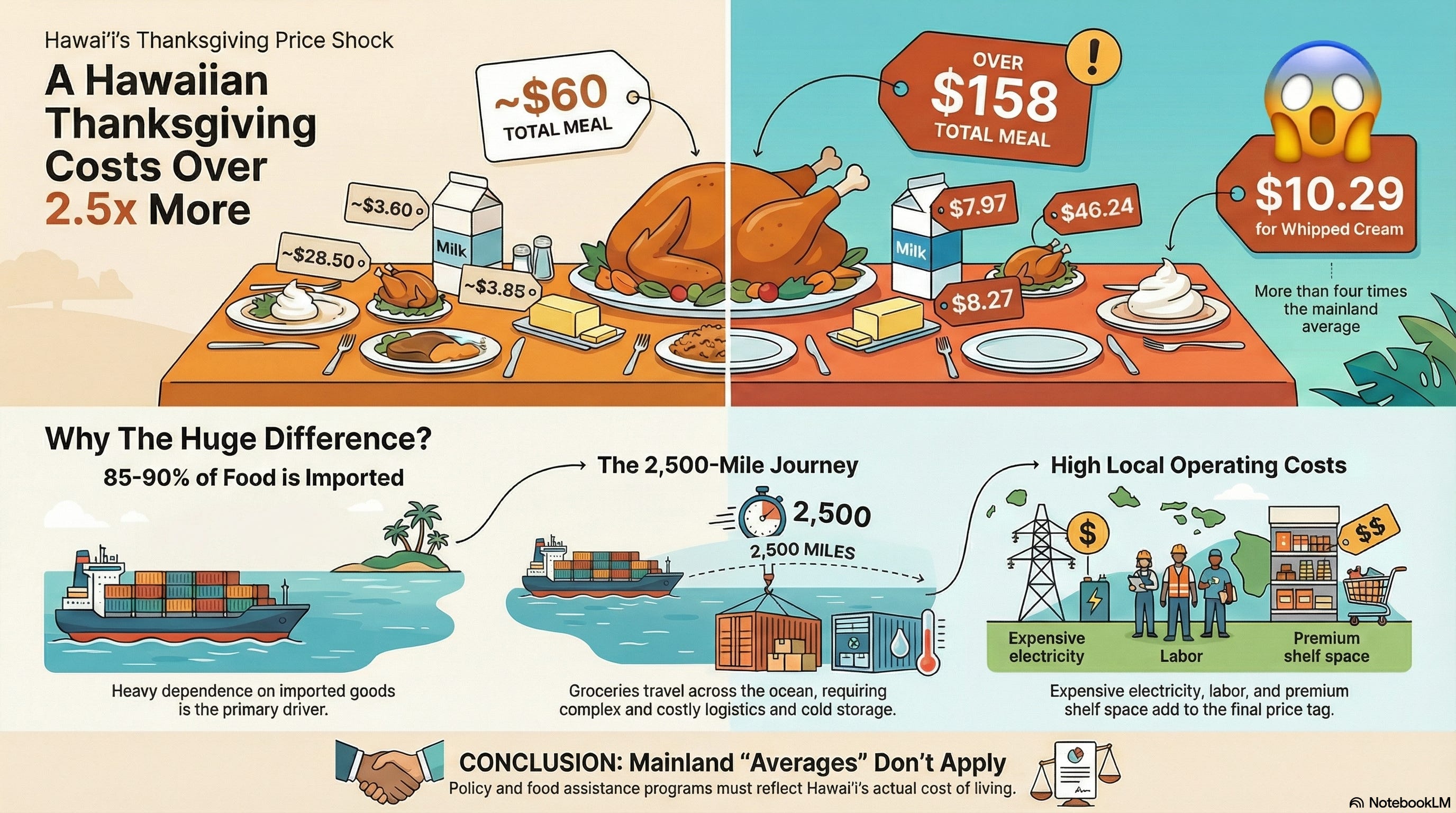
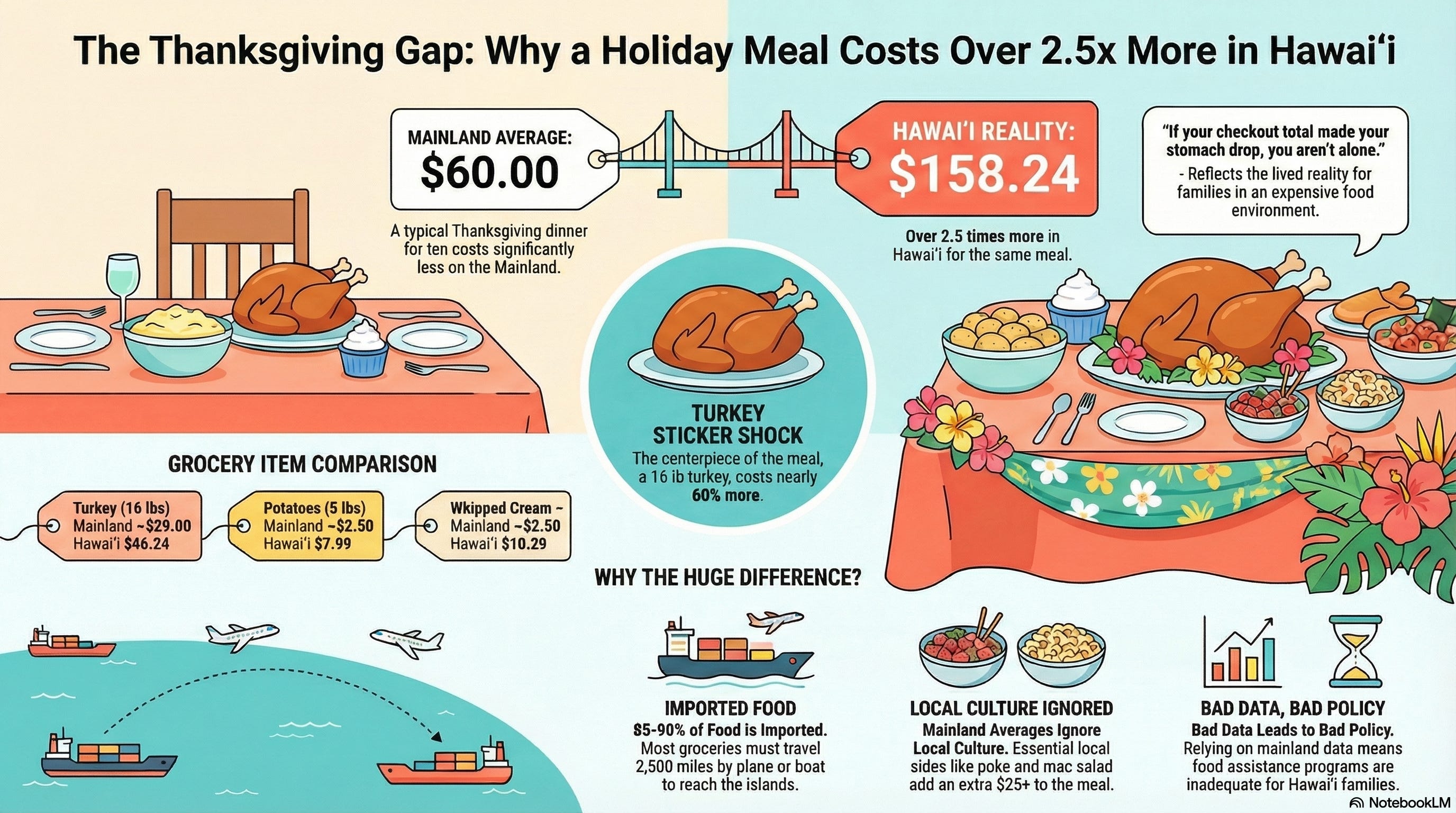
I priced out the same basic menu the American Farm Bureau uses for its annual “average Thanksgiving cost”—just purchased here, in Hawaiʻi, from a real store, with real prices. That cart came out to: $158.24
That’s not a lavish spread. That’s the Farm-Bureau-equivalent Thanksgiving basket; Hawaiʻi edition.
📊 Hawaiʻi vs Mainland - Average Thanksgiving for 10
Mainland (Farm Bureau): $60–$70
Hawaiʻi (same menu, same logic): $158.24
That gap isn’t indulgence. That’s geography, freight, energy, land costs, and scale showing up on a receipt.
Why the Grocery Store Isn’t the Villain; neither is the farmer!
I hear this a lot:
“Foodland is ridiculous. “Costco used to be affordable. “Don’t even get me started on foil.” (We’ll get to foil. Pinky Promise.)
But grocery stores aren’t the villains in this story. They’re the messengers—the point of contact between global systems and local reality.
When you’re standing in the aisle doing math like you’re on Beat Shazam, what you’re really doing is absorbing costs you had no hand in creating.
Almost everything in that cart traveled thousands of miles. Even if it was grown here, not flown here it still costs more to produce and deliver to your cart. Cold storage costs more here. Shelf space costs more here. Electricity costs more here. Labor costs more here. None of that is your personal failure.
But Here’s Where the Math Breaks
The $158.24 number is clean. Comparable. Defensible. It’s also incomplete.
Because that’s not what Thanksgiving actually looks like in most Hawaiʻi homes.
We don’t just cook “the national average.”We feed ʻohana. We add extra people. We add culture. Mac salad. Poke. Haupia. A second protein. Extra sides because someone’s cousin is always bringing friends.
When I totaled what Thanksgiving actually costs in my house—the real dinner, not the benchmark version—it landed right about $425
Not because we went wild. Because that’s what it takes to feed people here.
This is where the national metric falls apart. It has no way to price culture, generosity, or island reality.
This Didn’t Start With COVID — COVID Just Exposed It
It’s fair to ask the uncomfortable question:
Are groceries expensive because of shipping and islands and systems — or because prices were raised during COVID and never really came back down? (Spoiler alert; When a company raises prices they rarely go back down)
Or is it because Americans were spoiled by decades of cheap food? The honest answer is: all of the above.
For decades, food in the United States was historically cheap — not because it was efficient or fair, but because many of its real costs were pushed out of sight.
Farm labor was underpaid.
Environmental damage was absorbed by land and water, not balance sheets.
Federal policy rewarded scale and consolidation, not resilience.
Consumers were insulated from volatility by a system optimized for cheap abundance rather than long-term stability.
Cheap food wasn’t a natural outcome. It was a policy choice.
Then COVID hit — and that fragile bargain collapsed.
Supply chains broke.
Shipping costs spiked.
Processing plants shut down.
Labor disappeared overnight.
Prices rose fast, and in many cases, they never fully came back down.
Not because every cost stayed elevated — but because highly consolidated markets don’t rush to lower prices once consumers have absorbed the increase. What was framed as temporary quietly became permanent.
That’s not a conspiracy. That’s market power behaving exactly as designed.
And Hawaiʻi didn’t just experience inflation — we experienced amplification.
Because when nearly everything you eat is imported, every shock hits harder and lasts longer. A 10% increase on the mainland becomes 20–30% here. A “temporary disruption” becomes a multi-year adjustment. Headlines say inflation is easing, but grocery aisles tell a different story. That disconnect isn’t in your head.
It’s the result of a food system designed for the continent, not islands — one that assumes cheap land transport, massive scale, centralized processing, and constant throughput. Hawaiʻi sits permanently outside those assumptions, and we pay for it at checkout.
So when Thanksgiving costs about $425 in a Hawaiʻi home, that isn’t excess or inefficiency. It’s what happens when a system built on artificially cheap food collides with reality and places like Hawaiʻi absorb the cost longest and hardest.
A Brief Note on Foil (Because We Have To)
Let’s talk about aluminum foil.
Reynolds Wrap, two-pack, Costco: $25.99 (This btw is the best deal per sq ft you can get). I nearly passed out in the aisle.
That is more than an entire sit-down meal used to cost back in the day.
At that price, I’m washing and reusing foil as my tutu taught me.
That’s not “demand. ”That’s consolidation, shipping, and global commodity pricing colliding with everyday life.
Foil isn’t a luxury item. It’s a household staple. And it now costs like one.
That’s not a consumer problem. That’s a structural one.
What This Means for Hawaiʻi Families
If Thanksgiving felt harder to afford—more stressful to plan, heavier than it used to be—that’s not nostalgia talking. That’s lived reality.
You’re not bad at money. You’re not doing it wrong. You’re navigating one of the most expensive food environments in the country with very little systemic support.
When national averages ignore places like Hawaiʻi:
Benefits don’t stretch.
Aid programs miss real need.
Cost-of-living comparisons fail.
And families are told—implicitly or explicitly—that the problem is their choices.
It isn’t.
The Kitchen-Table Truth
Thanksgiving in Hawaiʻi has always been about more than food.
It’s about showing up.
Stretching meals.
Feeding more people than planned.
Making do — without apology.
But we don’t have to pretend it’s normal for a basic holiday meal to feel like a budgeting exercise every single year.
When food costs are framed as personal failure rather than systemic design, the pressure is placed on families who are already doing their best. Naming that isn’t complaining. It’s clarity.
If you’ve ever stood in the grocery store and thought, Is it just me? — It’s not.
This is what it looks like when a food system built on artificially low prices, long supply chains, and mainland assumptions meets island reality. The gap shows up quietly, item by item, until it hits all at once at checkout.
This is why I write here.
Not to romanticize the policies or the struggle.
Not to offer shopping tips as policy.
But to translate what’s happening — plainly, honestly, and without condescension.
Because when we can name the system, we can stop blaming ourselves.
Pull up a chair.
We’ll keep making sense of it together.
Lorie
She Writes for Food