

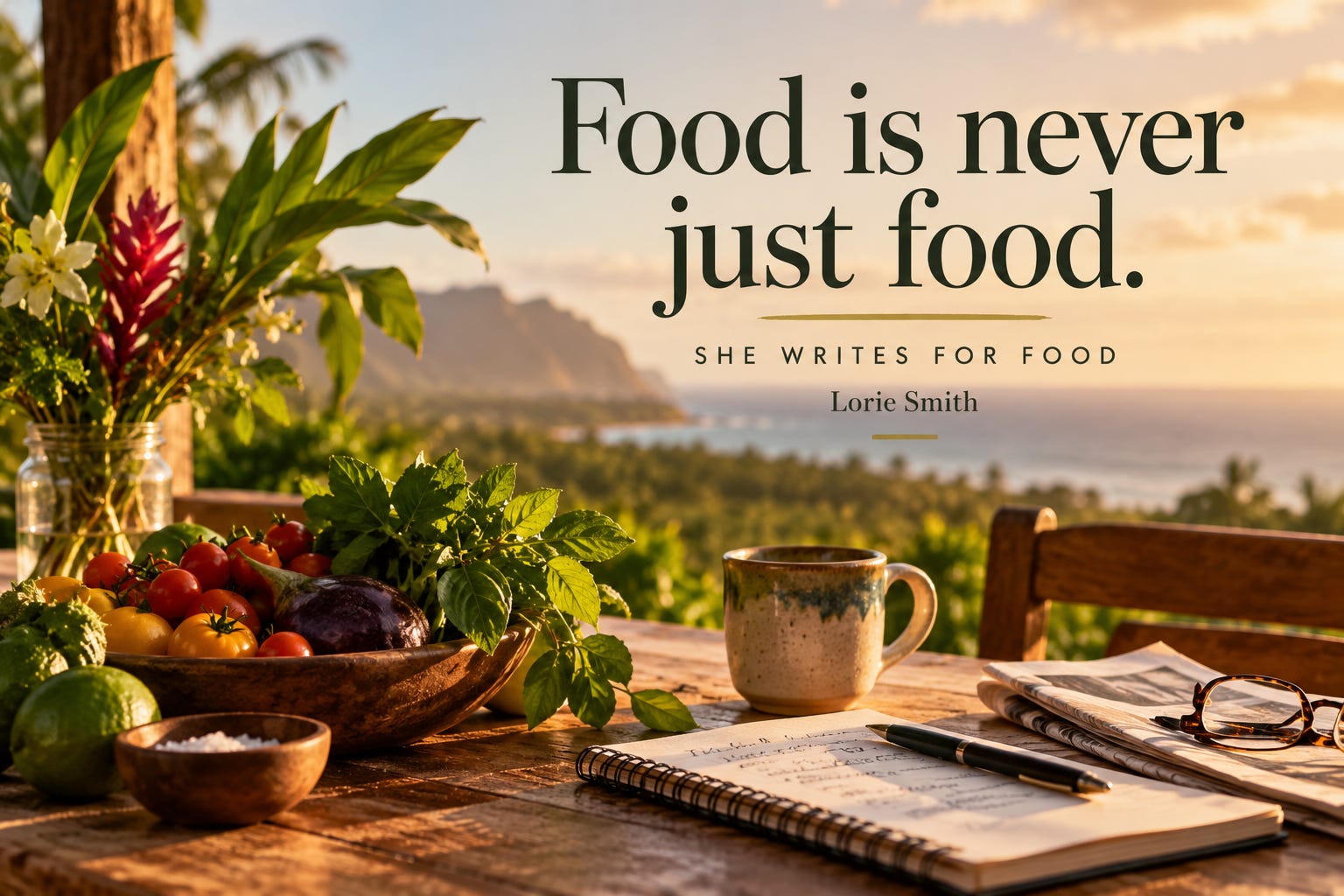
A She Writes for Food manifesto
Food and agriculture are where I’ve spent most of my career, working where agriculture, advocacy, communications, policy and public opinion collide.
For a long time, I assumed that was my industry—without realizing how much bigger the conversation was.
Somewhere along the way, I realized the hardest questions around food weren’t really about food at all.
They were about science, economics, politics, identity and the stories we tell ourselves about how things ought to work.
We know what it feels like to stand in a grocery store and wonder why something costs so much.
We know the difference between a tomato that tastes like a tomato and one that traveled 3,000 miles to get here.
We know family recipes, favorite restaurants, farmers markets, school lunches, Sunday dinners and the foods that somehow taste like home.
Food feels simple.
It isn’t.
I’ve watched a Hawaiʻi ranching issue that began with conservation easements and state agricultural leases take decades to work its way through laws, agencies and policy changes—and still end with something closer to a workaround than a clean fix.
That’s what happens when you start pulling on the thread.
Pull on the thread
Follow almost any plate far enough and you run into land, water, labor, transportation, business, science, culture, politics, policy, ownership and regulation.
You run into questions about who makes decisions, who pays for them and who benefits.
Eventually, all those enormous systems end up somewhere very small:
At our kitchen table.
That’s probably why I never managed to stay neatly inside one category.
So I made my own.
She Writes for Food is less about food as a subject and more about food as a way of looking at the world.
I want to know why something costs what it costs.
Where the money went.
Why a program that sounds wonderful on paper can be nearly impossible for a normal person to navigate.
Why we keep talking about supporting local agriculture while making it increasingly difficult to farm.
And I want to understand the rules, incentives and systems beneath whatever everyone else is arguing about—and then explain them in plain English.
The questions get bigger
That curiosity has carried me far beyond food.
Into politics.
Money.
Work.
Business.
Technology.
Family.
Hawaiʻi.
And increasingly, into the questions I ask about almost everything:
What’s true? What matters? What makes sense? And what should we do with that information?
Because we do not need more noise.
We have plenty.
Endless feeds. Hot takes. Marketing funnels. Political outrage. AI-generated answers. Experts contradicting one another. And approximately 447 people online ready to explain why you’re doing everything wrong.
I’m interested in something else.
Taking complicated things apart.
Looking at the numbers.
Following the incentives.
Reading the fine print.
Asking better questions.
Talking to people who actually know what they’re doing.
Then translating what I find into something useful.
This won’t always be about food
Sometimes that will mean food, agriculture, land or public policy.
Sometimes money, business or technology.
And sometimes it will be more personal: work, family, responsibility, getting older and deciding what deserves our energy in the next chapter of our lives.
Because food connects almost everything.
Pull that thread far enough and the questions get bigger.
How do we build communities that actually work?
How do we support the people producing the things we say we value?
How do we tell the difference between a good idea and good marketing?
How do we make better decisions when almost everyone wants some portion of our money, attention or outrage?
And maybe most importantly:
How do we spend what we have well?
Our money.
Our work.
Our attention.
Our time.
Our lives.
I don’t have tidy answers.
That’s not really the point.
I want this to be a place where we can investigate the questions.
Where curiosity is welcome.
Where changing your mind when the evidence changes is considered a strength.
Where politics doesn’t have to become a team sport.
Where data and lived experience can sit at the same table.
Where Hawaiʻi is not scenery in the background, but a real place with complicated problems, extraordinary people and lessons worth paying attention to.
And where we remember that a good life isn’t necessarily about accumulating more.
Sometimes it’s about paying closer attention to what we already have.
Food will always have a seat at this table.
It just isn’t the only thing we’re talking about anymore.
I’ll be here each week, following the numbers, asking better questions and bringing back what’s worth knowing.
Pull up a chair.
Aloha,
Lorie 🌺
Love it!
*drags the chair over ~ pours the coffee*